

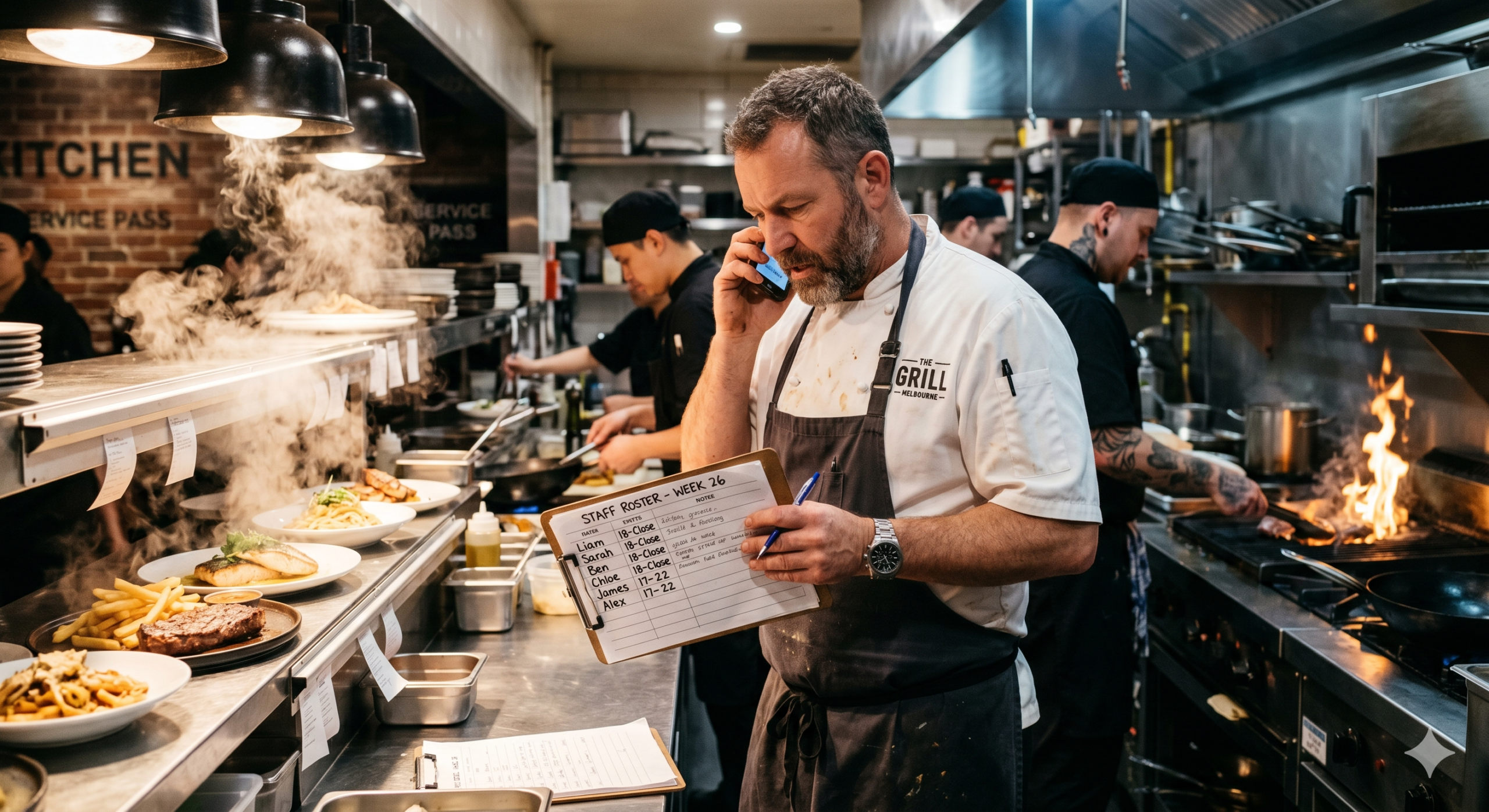
The wage underpayment cases that swept through Australian hospitality didn’t mostly involve employers deliberately stealing wages. They involved operators running payroll on the wrong award, classifying employees in the wrong grade, or applying Saturday penalty rates to a Sunday shift. The amounts were wrong — but the intent was compliance. That distinction carries little weight with Fair Work, and hospitality payroll in Australia is the area where that lesson keeps getting relearned.
Which award covers your venue — and why getting it wrong matters
Two awards govern most Australian hospitality businesses, and they are not interchangeable.
The Restaurant Industry Award 2020 (MA000119) covers restaurants, cafés, tea rooms, reception centres, and roadhouses where food service is the primary function of the business.
The Hospitality Industry General Award 2020 (MA000009) covers hotels, motels, pubs, taverns, bars, accommodation venues, and catering businesses where hospitality service — rather than food — is the primary offering.
If you run a café inside a hotel, you’re under the Hospitality Award. If you run a standalone restaurant with a bar, you’re under the Restaurant Award. The test is what the business primarily does, not what physical structure it operates in. This matters because the two awards have different base rates, different classification structures, and — critically — different penalty rate multipliers for weekend and public holiday work. Running a pub’s staff under the Restaurant Award isn’t a technicality. It means applying the wrong rates to every single shift.
Prefer to talk it through? Call 1300 66 88 14 or send us an enquiry. We reply within one business day.
Penalty rate multipliers: Restaurant Award vs Hospitality Award
This is where most errors occur. The penalty rate multipliers for casual employees under each award, as amended to 1 July 2026. The weekend and public holiday figures already include the 25% casual loading:
Restaurant Industry Award 2020 (MA000119) — casual employee:
- Monday to Friday: base rate + 25% casual loading
- Saturday: 1.50x base rate
- Sunday: 1.50x base rate for Introductory to Level 2, 1.75x for Level 3 to Level 6
- Public holiday: 2.50x base rate
Hospitality Industry General Award 2020 (MA000009) — casual employee:
- Monday to Friday: base rate + 25% casual loading
- Saturday: 1.50x base rate
- Sunday: 1.75x base rate
- Public holiday: 2.50x base rate
The Sunday rate alone, 1.75x for every casual under the Hospitality Award but 1.50x for a Restaurant Award casual below Level 3, means a venue running payroll under the wrong award will be underpaying or overpaying every Sunday shift. Underpaying is the one that creates liability. Full-time and part-time employees carry their own separate rate structures. Junior employees under 21 are paid percentages of the adult rate based on age. Apprentice cooks have separate rates entirely. Applying adult casual rates across the board is wrong for most hospitality workforces.
⚠ Fair Work Underpayment Risk
Back-pay liability extends up to 6 years
The largest hospitality underpayment recoveries in Australia have exceeded $7.8 million across 500+ employees. In most reported cases, the root cause was incorrect award coverage, wrong classification, or miscalculated penalty rates — not deliberate theft. The 6-year lookback period means historic errors compound quickly for venues with large casual workforces.
The classification problem most venues don’t catch until it’s too late
Each award contains a classification structure — typically Grade 1 through Grade 6 — with different minimum rates at each level. A Grade 1 food and beverage attendant (taking counter orders) earns a different minimum rate than a Grade 3 (cooking, making coffee, handling cash, and training others).
Most payroll errors don’t start with the wrong penalty multiplier. They start with classification. An operator who classifies all floor staff at Grade 1 will underpay anyone whose actual duties meet Grade 2 or Grade 3 criteria. The classification determines the minimum rate — it’s a floor, not a negotiating position. Fair Work’s approach in audits is to assess what an employee actually does, not what their contract calls their role. A classification review should happen when an employee’s duties change, not just at the point of hire.
GST in hospitality: what’s taxable and what catches operators out

Hospitality has its own GST complexity. Under the ATO’s food and GST rules, the basic food exemption creates a carve-out that catches venues and bookkeepers who aren’t across the detail.
In practice, almost everything a restaurant or café sells is a taxable supply: meals, drinks, takeaway food prepared and ready to eat, alcohol, soft drinks, and confectionery. Hot food sold hot is always taxable regardless of what it is. The “basic food” GST-free provision applies to unprocessed food for home preparation — not to anything served ready to eat at your counter or table.
The areas that regularly trip up hospitality operators and their bookkeepers:
- Gift vouchers: not taxable at the point of sale — the GST event occurs when the voucher is redeemed
- Tips: not consideration for supply and therefore not subject to GST, though they may be assessable income for employees
- Packaged goods sold at the counter: a bag of retail coffee beans or a bottled sauce may qualify as GST-free basic food and needs to be coded separately from prepared food and drink
- Catering for home consumption: food supplied as a platter for a customer to take home and serve may carry a different GST treatment than your standard dine-in supplies
For a full overview of BAS obligations and quarterly lodgement requirements, see the BAS and ATO page.
Monthly vs Quarterly BAS
Hospitality venues with GST turnover under $20 million lodge and pay BAS quarterly. If your group turns over more than $20 million, the obligation shifts to monthly lodgement — 12 BAS periods per year rather than 4. Multi-site operators should confirm which obligation applies at their current turnover level.
Superannuation and ordinary time earnings in hospitality
From 1 July 2025, the superannuation guarantee rate is 12% of ordinary time earnings (OTE). The hospitality-specific complexity is separating OTE from overtime when your workforce is heavily casual and working penalty rate shifts.
Ordinary time earnings include base hourly rate and casual loading. Penalty rates for Saturday, Sunday, and public holiday shifts are OTE — super is payable on those loadings. Overtime is not OTE — super is not payable on hours worked beyond the employee’s ordinary hours as defined in the applicable award. Annual leave loading under the Hospitality Award is 17.5%, and super is generally payable on it too; see our annual leave loading guide.
For a casual employee working a Sunday double shift with an overtime component, the correct super calculation requires separating ordinary time Sunday hours (penalty rate — OTE, super applies) from overtime hours (not OTE, no super). Calculating super on total gross pay overstates the obligation. Calculating it on base rate alone understates it. From 1 July 2026, Payday Super requires superannuation to be paid with every payroll cycle rather than quarterly. Missed deadlines trigger the Superannuation Guarantee Charge, which adds interest, an administration levy, and removes the employer’s tax deduction for contributions.
What goes wrong most often — and what it costs
Based on Fair Work Ombudsman enforcement activity in hospitality, the most common payroll failures are:
- Wrong award coverage — particularly bar-and-food venues using the Restaurant Award when the Hospitality Award applies
- Incorrect casual loading — failing to add the 25% loading on top of base rates for casual employees
- Sunday rate errors — applying Saturday multipliers to Sunday shifts
- Junior employee rates — applying adult minimum rates to under-21 staff
- Pay slips not issued on time — required within one working day of payment under both awards
Underpayment identified in a Fair Work audit carries a back-payment obligation for all affected employees for up to 6 years. For a venue with 20 casual staff working weekend shifts over several years, the exposure can reach hundreds of thousands of dollars before civil penalty proceedings are considered. The Fair Work Ombudsman’s small business compliance program specifically targets hospitality — it’s consistently one of the most audited industries in Australia.
What Free My Cloud handles for hospitality businesses
Penalty rate payroll under the correct award for your venue type · Classification review at onboarding · STP lodgement every pay event · Super calculated on correct OTE, paid by ATO deadlines · Daily POS reconciliation · Food and beverage cost tracking · Supplier invoice management · BAS preparation quarterly · Monthly P&L by revenue stream
Hospitality payroll is genuinely complex — two awards, multiple classification grades, casual loadings, penalty rates that vary by day and shift type, and a super obligation that requires separating OTE from overtime on every pay run. The way to keep it clean is to confirm the correct award and classification at hire, run a payroll system that applies shift-specific rates automatically, and review classifications as duties change over time.
The Free My Cloud hospitality bookkeeping page covers the full scope of what a dedicated bookkeeper handles for restaurants, cafés, bars, and hotels. The outsourced payroll page covers our payroll process specifically. Use the savings calculator to compare costs against a local hire, or contact us directly if you have a specific compliance question. If you are still choosing the platform that runs this payroll, our guide to accounting software for hospitality compares Xero, MYOB, QuickBooks and Reckon for cafes, restaurants and bars.
The Restaurant Industry Award 2020 (MA000119) covers most restaurants, cafés, tea rooms, and reception centres where food service is the primary business function. The Hospitality Industry General Award 2020 (MA000009) covers hotels, pubs, bars, accommodation venues, and catering businesses. Using the wrong award means every pay calculation is based on incorrect rates.
Under the Hospitality Industry (General) Award 2020, casual employees earn 1.75x their base rate on Sundays, inclusive of the casual loading. Under the Restaurant Industry Award 2020, casuals earn 1.50x on Sundays at Introductory to Level 2 and 1.75x at Level 3 and above. Public holiday work is 2.50x for casuals under both awards. Confirming which award applies to your venue is the essential first step.
Yes. Penalty rates for Saturday, Sunday, and public holiday shifts are considered ordinary time earnings (OTE), and superannuation is payable on OTE at the current rate of 12% from 1 July 2025. Overtime — hours beyond the ordinary hours defined in the applicable award — is not OTE and does not attract super.
Fair Work can require back-payment for underpayment going back up to 6 years. For a venue with a large casual workforce working penalty rate shifts, historic errors in award coverage, classification, or penalty rate calculation can accumulate into significant liabilities over that period.
Classification under both the Restaurant Award and Hospitality Award is based on what an employee actually does, not their job title. Grades 1 through 6 are defined by the duties performed — taking orders, preparing food, supervising staff, training others. If an employee has taken on additional responsibilities since they were hired, their classification — and minimum rate — may need to be reviewed.
Talk to FreeMyCloud
Call 1300 66 88 14, or send us an enquiry and we reply within one business day.
Disclaimer: This article provides general information only and does not constitute financial, taxation or legal advice. It does not take into account your objectives, financial situation or particular needs. Rates, thresholds and obligations change — the information here is current as at 31 August 2026. Before acting on anything in this article, please speak to your accountant, registered tax agent or financial adviser.