
 Sole traders and Pty Ltd companies, Australia
A dedicated, university-qualified graduate accountant keeps your books current every week: bank accounts reconciled, invoices sent and followed up, bills and receipts recorded, and GST and BAS figures ready for your registered BAS or tax agent. Your bookkeeper is based in the Philippines and works in your Xero, MYOB or QuickBooks file during Australian business hours.
The short answer
Sole trader bookkeeping is the weekly record of what the business earned, what it spent and what it owes in tax. Each sale and each expense is recorded with its document, the bank account is reconciled, and GST is tracked as it builds up. At the end of the year the figures go into your own tax return, because a sole trader and the business are the same taxpayer.
A Pty Ltd company needs the same weekly work and a little more. The company is a separate legal entity with its own bank account and its own tax return, so money moving between you and the company has to be recorded for what it is: wages, directors’ fees, a loan or a dividend.
Sole trader or company
The two structures are recorded differently. These points are as published by business.gov.au and the ATO.
| In the books | Sole trader | Pty Ltd company |
|---|---|---|
| Who the taxpayer is | You. The business uses your individual tax file number | The company, which is a separate legal entity |
| Bank account | A separate business account is not required, although it is recommended | A separate business bank account is mandatory |
| Taking money out | You can withdraw money from the business account | Money the company earns belongs to the company. It may pay you wages or directors’ fees |
| Tax return | Business income and expenses go in your individual tax return | The company lodges its own tax return |
| How long records are kept | At least 5 years | Tax records at least 5 years. Financial records at least 7 years |
| Yearly review | None | An annual review by ASIC, with a review fee |
| Super and tax withheld | You can choose whether to pay super to yourself. Super is payable for eligible employees | Directors are responsible for making sure the company meets its PAYG withholding and super obligations |
Sources, read on 29 September 2026: business.gov.au, Sole trader, Company and Difference between a sole trader and a company; ATO, Work out if you have to pay super; ASIC, Company annual review. Which structure suits a business is a question for your accountant or lawyer.
What the books have to cover
The same six jobs apply whether you trade under your own name or through a company.
Invoices sent as the work is done, payments matched as they arrive and overdue accounts followed up on a set schedule.
Each expense recorded with its document attached, and business spending kept apart from private spending.
A business must register for GST once its GST turnover reaches $75,000 (ATO). From then on, GST is recorded on every sale and purchase and the BAS figures are prepared each quarter.
PAYG instalments are regular prepayments of the expected tax on business and investment income (ATO). Monthly reports show what has been set aside and what is coming due.
If you employ staff, pay runs and super are prepared for your approval. For earnings paid from 1 July 2026, super must reach each employee’s fund within 7 business days of payday (ATO).
Reconciled accounts, asset purchases and loan balances assembled for your registered tax agent, who prepares and lodges the return.
Who does what
| Task | Your FreeMyCloud bookkeeper | Your registered tax or BAS agent |
|---|---|---|
| Weekly books | Codes the bank feed, enters bills and receipts, reconciles every account | Not involved week to week |
| GST and BAS | Records GST on every transaction and prepares the BAS figures and workpapers | Reviews and lodges the BAS |
| Payroll | Prepares pay runs and super for your approval | Advises on payroll questions |
| Tax return | Closes the year and assembles the year-end file | Prepares and lodges the return and gives tax advice |
| Business structure | Records the structure you have | Advises whether to trade as a sole trader or a company |
Only a registered BAS agent or tax agent can provide BAS or tax agent services for a fee in Australia (Tax Practitioners Board). FreeMyCloud is not a registered tax agent and does not prepare or lodge tax returns. If you do not yet have a registered agent, the Board keeps a public register where you can find one.
What is handled
One person working in your accounting software, to a routine you agree at the start.
Bank and card feeds coded and every account reconciled, with private items marked for you to confirm.
Invoices raised from your job notes or timesheets, and overdue accounts followed up.
Supplier bills entered, receipts filed against each entry and payment runs prepared for your approval.
BAS figures and workpapers prepared each quarter for your registered BAS or tax agent to review and lodge.
Pay runs, payroll reports and super prepared for your approval, where you employ staff.
Profit and loss, balance sheet and the amounts set aside for GST and tax.
Software
FreeMyCloud bookkeepers are able to work with Xero, MYOB, QuickBooks and Reckon. There is no need to change platforms, and you decide what access your bookkeeper has.
If the business has no accounting software yet, your accountant can recommend one and your bookkeeper starts from the first bank feed.
Xero, MYOB, QuickBooks or Reckon, whichever the business already uses.
Bills and receipts collected through tools such as Dext or Hubdoc, or photographed on your phone.
Quoting, job notes and approvals stay as you have set them.
User permissions set by you, removable by you, with a signed NDA in place.
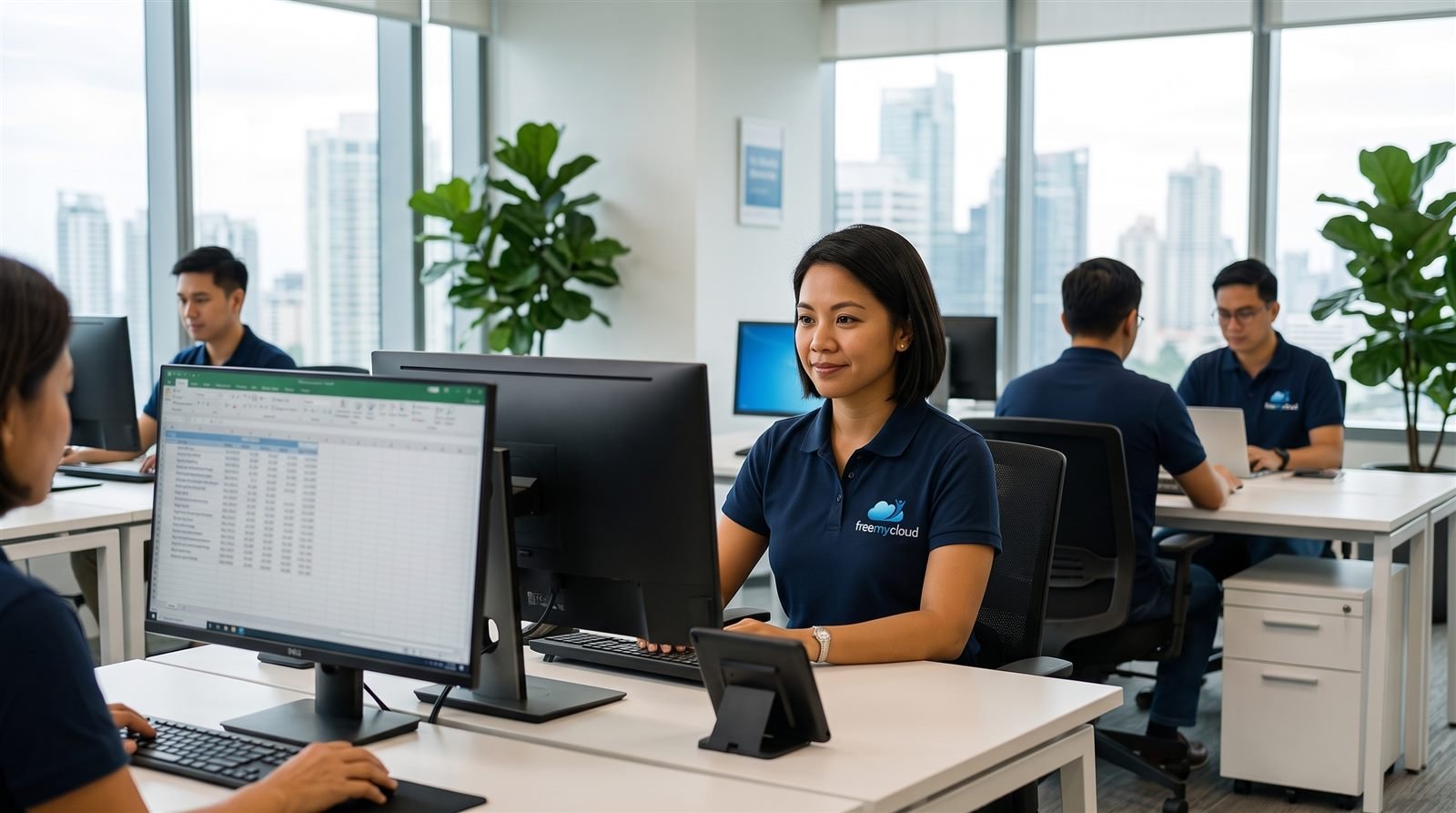
Your bookkeeper is a university-qualified graduate accountant with Australian experience, employed by FreeMyCloud and based in our Manila office. The same person works on your file and is ready to start within three business days.
FreeMyCloud is Australian owned and was founded in 2010, with offices in Melbourne and Manila. Clients range from individual operators and sole traders to ASX-listed companies.
A dedicated FreeMyCloud bookkeeper typically costs 50 to 70% less than a local equivalent. Engagements of any size are welcome, including a few hours a week, and the cost follows the hours and the transaction volume.
Getting started
Four steps, with no change to your software or your accountant.
You describe the business, your software and what is behind.
We match a graduate accountant to your software and workload.
The NDA is signed and you invite your bookkeeper into your accounting file.
Books every week, reports every month, BAS figures every quarter.
Guides and related pages
FreeMyCloud provides bookkeeping to sole traders and Pty Ltd companies in every state and territory. Because the work is done inside your cloud accounting file, it makes no difference where the business is based.
Most owners of a small business do the books themselves at first, at night or at the weekend. The work grows with the business: more invoices, a first employee, GST registration. Handing it to one person who does it every week gives those hours back and keeps the figures current.
When a sole trader moves to a company, the books change on the day the company starts trading. Your bookkeeper sets up the new file to your accountant’s instructions and keeps the two sets of records apart.
Frequently asked questions
A sole trader needs a record of every sale and every business expense, a reconciled bank account, GST tracked once registered, and records kept for at least 5 years. Where staff are employed, payroll and super records are added. The year-end figures go into the owner’s individual tax return.
No. business.gov.au states that a sole trader does not require a separate business bank account, although one is recommended because it makes business income and expenses easier to track. For a company a separate business bank account is mandatory. See Sole trader (read 29 September 2026).
The ATO requires a business to register for GST when its GST turnover is $75,000 or more. GST turnover is gross business income, not profit, and excludes GST. The rule is the same for sole traders and companies. See the ATO’s Registering for GST page (as at 29 September 2026).
No. business.gov.au states that business income and expenses go in the owner’s individual tax return, using a separate Business and professional items schedule. A company lodges its own tax return. See Difference between a sole trader and a company (read 29 September 2026).
No. The ATO states that a person who is self-employed as a sole trader does not have to pay super guarantee for themselves, and can make personal super contributions. Super is payable for eligible employees. See Work out if you have to pay super (as at 29 September 2026).
The company is a separate legal entity, so it has its own bank account, its own accounting file and its own tax return. Money the company earns belongs to the company, and payments to the owner are recorded as wages or directors’ fees. Financial records are kept for at least 7 years and ASIC reviews the company each year. Whether to change structure is a question for your accountant.
No. Only a registered BAS agent or tax agent can provide those services for a fee in Australia (Tax Practitioners Board). Your FreeMyCloud bookkeeper keeps the records and prepares the figures and workpapers. Your registered agent reviews and lodges them. Quarterly due dates are on the ATO’s BAS due dates page.
Yes. FreeMyCloud takes engagements of any size, including a few hours a week. The same person works on your file each time, there is no lock-in contract, and the hours can change as the business grows.
A dedicated FreeMyCloud bookkeeper typically costs 50 to 70% less than a local equivalent, with no setup fee and no lock-in contract. The figure depends on hours and transaction volume, and an engagement can be as small as a few hours a week. The cost page explains how it is worked out.
Most clients are running within three business days of the first call. The steps are a 30-minute call, matching a bookkeeper to your software and workload, signing the NDA and inviting your bookkeeper into your accounting file.
This page is general information about Australian bookkeeping and reporting obligations, current as at 29 September 2026. It is not tax, financial or legal advice. FreeMyCloud is not a registered tax agent and does not prepare or lodge tax returns. Rates, thresholds and dates change. Confirm your own position with your registered tax or BAS agent.
Fifteen minutes on the phone is enough to tell you whether a dedicated bookkeeper suits your business and what it would cost.
Or send a quick enquiry here
Tell us a little about your business. We reply within one business day.