
 Cloud bookkeeping services, Australia
Cloud bookkeeping is bookkeeping done inside your online accounting file by a person who signs in rather than visits. With FreeMyCloud that person is one dedicated, university-qualified graduate accountant, working Australian business hours in your Xero, MYOB, QuickBooks or Reckon file, for typically about 50% less than an in-house bookkeeper. No lock-in contract and no setup fee.
The short answer
Cloud bookkeeping is keeping a business’s books inside cloud accounting software such as Xero, MYOB Business, QuickBooks Online or Reckon One, by a bookkeeper who signs in to the file rather than sitting at a desk in your office. The bank feed brings transactions in, receipts and bills arrive as photos and emails, and the bookkeeper codes, reconciles, prepares the pay run and produces the monthly reports from wherever they are. The same arrangement is also called online bookkeeping or a cloud accounting service.
The cost has two parts. The software is the small part: the entry plans from Xero and MYOB are $37 and $35 a month at 1 October 2026, and the table below shows the sources. The bookkeeper is the large part. A local bookkeeper typically costs $65,000 to $85,000 a year once super, leave and the time spent managing them are counted. A dedicated FreeMyCloud cloud bookkeeper typically costs about 50% less than that, with no setup fee and no lock-in contract. The bookkeeper cost page explains how the figure for your business is worked out.
FreeMyCloud works in Xero, MYOB, QuickBooks and Reckon, and in the job, practice and point-of-sale software that feeds them. You keep your file, your subscription and your accountant, and your bookkeeper is given a user login that you control. Our Xero, MYOB and QuickBooks bookkeeping pages cover each package.
What it costs
Three lines make up the cost: the software subscription, the person who keeps the file, and the on-costs of employing that person. Software prices are as published on each vendor’s Australian pricing page on 1 October 2026, after any introductory discount ends.
| Cost line | In-house bookkeeper | Dedicated cloud bookkeeper from FreeMyCloud |
|---|---|---|
| Accounting software | Xero Ignite $37 a month or MYOB Business Lite $35 a month, GST included. QuickBooks Online and Reckon One sit in the same range | The same subscription. The file stays in your name |
| The bookkeeper | Typically $65,000 to $85,000 a year once super, leave and the time spent managing them are counted | A monthly fee, typically about 50% less, set by hours and transaction volume |
| Super, leave and recruitment | Paid by you on top of wages | Included in the fee. Leave cover is arranged by FreeMyCloud |
| Desk, computer and software seats | Provided by you | Provided by FreeMyCloud in our Manila office |
| Setup and contract | Recruitment fees and a notice period | No setup fee and no lock-in contract |
Sources: Xero AU pricing plans (Ignite, AUD per month, GST included) and MYOB Australia pricing (MYOB Business Lite, after the offer period), read on 1 October 2026. QuickBooks Online and Reckon One publish their plans on their own pages; Reckon’s published comparison lists them at $33 and $24 a month. Vendors change prices at any time.
Where the saving comes from. Nothing about the software changes. The saving is in the person: a graduate accountant employed by FreeMyCloud in our Manila office costs a fraction of a Melbourne or Sydney salary, and the on-costs of employment do not fall on you.
Day to day
| When | What your cloud bookkeeper does | What you see |
|---|---|---|
| Every day | Codes the bank feed transactions in your software and matches each one to its receipt or bill | A bank feed with nothing left waiting |
| As receipts and bills arrive | Receipts photographed on a phone and bills forwarded to a capture address are read, coded and attached to the transaction | Every expense with its document behind it |
| Weekly | Reconciles bank, card and merchant accounts, sends invoices and statements, follows up overdue accounts and prepares the payment run for your approval | Current lists of what you owe and what you are owed |
| Each pay run | Prepares the pay run, the Single Touch Payroll report and the super payment for your approval | Pay and super ready to approve on payday |
| Monthly | Closes the month and prepares the profit and loss, balance sheet and cash flow, with notes on the movements | Management reports for the month just finished |
| Quarterly | Prepares the BAS figures and workpapers for your registered BAS or tax agent to review and lodge | A BAS ready for your agent |
Super is part of every pay run. For employee earnings paid from 1 July 2026, the contribution must be received by the employee’s fund within 7 business days of payday (ATO, Payment deadlines for Payday Super, last updated 29 September 2026).
Only a registered BAS agent or tax agent can provide BAS services for a fee in Australia (Tax Practitioners Board, BAS services). FreeMyCloud is not a registered tax or BAS agent. Your bookkeeper prepares the figures; your registered agent reviews and lodges them.
Get in touch
Tell us a little about your business and what you need looked after. We reply within one business day, Australia-wide, and fifteen minutes on the phone is enough to say whether a dedicated bookkeeper suits you and what it would cost.
Prefer to talk? 1300 66 88 14
Scope
One person, working in your software and following your processes, covering the bookkeeping a business needs every week.
Every transaction coded against your chart of accounts, with the receipt or bill attached, and every account reconciled on a set schedule.
Bills and receipts collected through Dext, Hubdoc or your software's own app, read, coded and scheduled for your approval.
Invoices sent, statements issued and overdue accounts followed up each week.
Pay runs, Single Touch Payroll reports and super payments prepared for your approval.
Profit and loss, balance sheet and cash flow each month, with the notes that explain the movements.
Quarterly figures and year-end schedules prepared for your registered agent to review and lodge.
Also available: setting up a new cloud accounting package, catch-up work on books that have fallen behind, and outsourced payroll on its own.
Software
Each of the four main cloud accounting packages used in Australia does the same core job: bank feeds, invoicing, bills, payroll and reporting. Your bookkeeper works in whichever one you already have, and in the receipt capture, job and point-of-sale systems that connect to it. If you are choosing for the first time, your accountant's preference usually decides it, because they work in the same file at year end.
Bank feeds, invoicing, bills, payroll and reporting in one file, with multi-factor authentication at sign-in. Xero bookkeeping services.
Lite and Pro plans that run in the browser, with two-factor authentication and passkeys. MYOB bookkeeping services.
Simple Start through to Advanced, with multi-factor authentication and encryption at rest and in transit. QuickBooks bookkeeping services.
Australian cloud accounting with data stored in Amazon Web Services data centres in the Sydney region, and multi-factor authentication.
Security and data handling
Cloud bookkeeping moves nothing out of your software. Your data stays in your accounting file with the vendor's own protections, and your bookkeeper is one more user whose access you set and can remove.
| Layer | What is in place | Source |
|---|---|---|
| Where the data is stored | In your software vendor's data centres, not on FreeMyCloud systems. Reckon states its cloud products store data in AWS data centres in the Sydney region. Xero encrypts data in transit and at rest. QuickBooks Online runs in Intuit-operated and AWS data centres with encryption at rest and in transit. MYOB bases its controls on ISO 27001. | Reckon, Security and data protection; Xero, Security; QuickBooks, Data security; MYOB, Security. All read on 1 October 2026 |
| Sign-in | Multi-factor or two-factor authentication is offered by all four vendors and is switched on for your bookkeeper's login | The vendor security pages above |
| Access | You create the user, choose the permission level and can remove access at any time. Changes in the file are recorded against the user who made them | Your software's user settings |
| Confidentiality | Every FreeMyCloud staff member signs a confidentiality agreement, and every client engagement starts with a signed non-disclosure agreement | FreeMyCloud engagement terms and privacy policy |
| Tax Practitioners Board | A registered tax or BAS agent must have the client's permission before client information goes to a third party, and must say to whom and where it will be disclosed, including overseas servers (Code item 6) | TPB, Confidentiality of client information (last modified 30 April 2026) and TPB, Outsourcing and offshoring |
| Privacy Act | An organisation covered by the Act takes reasonable steps to ensure an overseas recipient handles personal information in line with the Australian Privacy Principles, and stays accountable for it (APP 8) | Office of the Australian Information Commissioner, APP 8 |
| ATO record keeping | Records may be kept digitally, stored so they cannot be changed, kept for 5 years in most cases, and in English or easily converted to English | ATO, Overview of record-keeping rules for business (last updated 18 June 2026) |
FreeMyCloud supplies the NDA and the details your engagement letter needs, so that your registered agent's obligations and your own under the Privacy Act are covered before work begins.
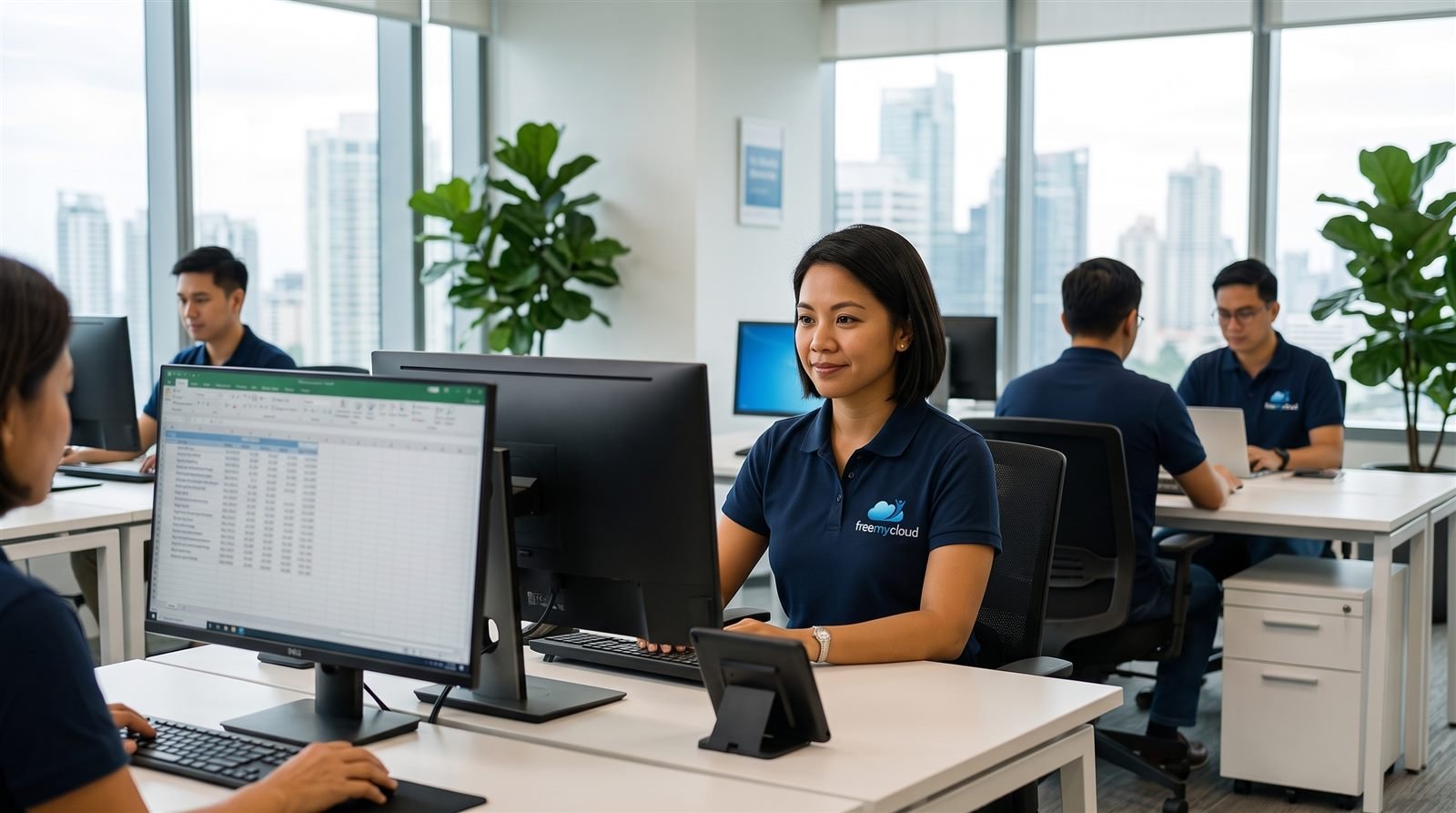
Your cloud bookkeeper is a university-qualified graduate accountant with Australian experience, employed by FreeMyCloud and based in our Manila office. The same person works on your file every day.
FreeMyCloud is Australian owned and was founded in 2010. We work with more than 200 Australian businesses, from sole traders and individual operators to ASX-listed companies, with offices in Melbourne and Manila.
A dedicated FreeMyCloud cloud bookkeeper typically costs about 50% less than an in-house bookkeeper. The figure for your business depends on hours and transaction volume, and the cost page sets out how it is worked out.
Getting started
Most clients are running within three business days of the first call, with no change to their software or their accountant.
You describe the business, the software you use and the work that needs doing.
We match a graduate accountant to your software and workload.
The NDA is signed and you invite your bookkeeper into your file at the permission level you choose.
Your bookkeeper clears the bank feed and follows your existing process from the first day.
Related pages
FreeMyCloud has provided cloud bookkeeping to Australian businesses since 2010, which is where the name comes from. Because the work is done inside your cloud accounting file, it makes no difference whether your business is in a capital city or a regional town.
A cloud bookkeeper and a virtual bookkeeper are the same role described from two angles: one names the software, the other names the distance. Where the person sits is a separate choice. FreeMyCloud bookkeepers are based in Manila, and our offshore accounting page sets out what Australian rules require of that arrangement and how it works in practice.
Clients range from sole traders to ASX-listed companies, across trades and construction, medical and dental practices, NDIS providers, hospitality, legal practices, real estate agencies and online businesses.
Frequently asked questions
Cloud bookkeeping is keeping a business's books inside online accounting software such as Xero, MYOB Business, QuickBooks Online or Reckon One, by a bookkeeper who signs in to the file rather than working at your premises. Bank feeds, photographed receipts and emailed bills bring the documents to the file, and the bookkeeper codes, reconciles, prepares pay runs and produces the monthly reports there.
In everyday use the two phrases overlap. Cloud bookkeeping is the weekly work of keeping the file current: coding, reconciling, bills, invoices, payroll preparation and monthly reports. Cloud accounting services, in the sense most people mean, add the work of a registered tax agent: the tax return, year-end accounts and tax advice. FreeMyCloud provides the first. Your own registered agent provides the second, working from the file your bookkeeper keeps.
The software is the small part: Xero Ignite is $37 a month and MYOB Business Lite is $35 a month on their Australian pricing pages at 1 October 2026. The bookkeeper is the large part. A local bookkeeper typically costs $65,000 to $85,000 a year with super, leave and management time counted. A dedicated FreeMyCloud bookkeeper typically costs about 50% less, with no setup fee and no lock-in contract. The cost page explains how it is worked out and the savings calculator gives an estimate.
Xero, MYOB Business, QuickBooks Online and Reckon One all handle bank feeds, invoicing, bills, payroll and reporting for an Australian small business. If you already use one, keep it: your bookkeeper works in that file and your accountant stays your accountant. If you are choosing for the first time, ask your accountant, because they work in the same file at year end. FreeMyCloud bookkeepers work in all four.
Your data stays in your accounting software, in the vendor's data centres, and never moves to FreeMyCloud systems. Reckon states its data is stored in AWS data centres in the Sydney region; Xero, MYOB and QuickBooks each describe encryption and multi-factor sign-in on their security pages. Your bookkeeper signs in with a user you create, at the permission level you choose, with two-factor authentication on, and you can remove access at any time. Every FreeMyCloud staff member signs a confidentiality agreement and every engagement begins with a signed NDA.
Only a registered BAS agent or tax agent can provide BAS services for a fee in Australia. FreeMyCloud is not a registered tax or BAS agent. Your bookkeeper keeps the records current and prepares the BAS figures and workpapers each quarter. Your registered agent reviews them and lodges.
Most clients are running within three business days of the first call. The steps are a 15-minute call, matching a bookkeeper to your software and workload, signing the NDA and inviting your bookkeeper into your file.
This page is general information about cloud bookkeeping arrangements and Australian reporting obligations, current as at 1 October 2026. It is not tax, financial or legal advice. FreeMyCloud is not a registered tax or BAS agent and does not prepare or lodge tax returns or activity statements. Software prices are as published by each vendor on that date and change without notice. Confirm your own position with your registered tax or BAS agent.
Fifteen minutes on the phone is enough to tell you whether a dedicated cloud bookkeeper suits your business and what it would cost.