

Last updated: 14 October 2026. Written by the FreeMyCloud team.
Checked against the Xero, MYOB, QuickBooks and Reckon pricing pages, the Fair Work Ombudsman’s Hospitality Award and Restaurant Award summaries and pay guides, and the ATO’s GST and food, Single Touch Payroll and Payday Super pages on 14 October 2026.
Accounting software for hospitality has to do four things that software for an ordinary small business does not: take sales from the point of sale (POS) every night without anyone retyping them, run payroll under the Hospitality Award or the Restaurant Industry Award with weekend, evening and public holiday rates, track food and beverage cost against sales week by week, and sort GST-free from taxable food. Xero, MYOB, QuickBooks Online and Reckon One can all do the ledger, BAS and Single Touch Payroll; the differences are in how each one connects to your till and your roster, what payroll costs per employee, and how much of the award work the software does for you.
This guide to accounting software for hospitality is for cafe, restaurant, bar and pub owners and the office managers and bookkeepers who keep their books. It compares the four main accounting platforms for a hospitality business, explains the POS and rostering connections that make them useful, sets out what the two awards and the ATO ask of your payroll and GST, and gives a weekly, monthly and quarterly hospitality bookkeeping routine you can hand to whoever does the books.
- Which software? Xero or MYOB Business for most venues, because both connect to the common POS and rostering apps and both price payroll per employee. QuickBooks Online suits a venue that already uses it; Reckon One is the lowest-cost ledger for a small cafe with a short roster.
- What does it cost? List prices on 14 October 2026: Xero from $37 a month (Ignite) to $107 (Comprehensive) and $143 (Ultimate 10); MYOB Business from $315 a year (Lite) or $70 a month (Pro, plus $3 a month per employee); QuickBooks Online from $33 (Simple Start) with payroll at $6 per employee; Reckon One from $24 (Accounting Plus) plus $16 or $32 for payroll. Prices include GST.
- Which award? Restaurants, eat-in cafes, tea rooms and reception centres: the Restaurant Industry Award. Hotels, motels, pubs, wine bars, taverns, caterers, casinos and restaurants inside a hotel: the Hospitality Industry (General) Award. Takeaway-only shops: the Fast Food Industry Award. Registered clubs: the Registered and Licensed Clubs Award.
- GST on food? Everything eaten on the premises is taxable, and so is all takeaway hot food and drink. Basic food sold cold to take away (a loaf of bread, unflavoured milk, a bag of beans) can be GST-free. Your POS must carry both tax codes.
- Payroll rules? Every pay run is reported through Single Touch Payroll, and from 1 July 2026 super guarantee must reach each employee’s fund within seven business days of payday under Payday Super.
- Who runs it? A dedicated FreeMyCloud accountant can run the whole hospitality routine in your own Xero or MYOB file for about 50% less than employing a bookkeeper locally. See hospitality bookkeeping.
What does accounting software for hospitality need to do?
A venue is a high-volume, low-margin business with a seven-day week, a casual-heavy roster and a product that goes off. Generic accounting software was built for a business that sends twenty invoices a month. A cafe can take 400 payments a day. The software you choose must cope with that volume without manual entry, and it must connect to the systems that actually run the venue. Before you compare plans, check each platform against this list.
- A POS feed. Daily sales, split by payment type (cash, card, delivery platform), with the GST split carried across, posted automatically as a daily summary. Square, Lightspeed Restaurant, Tyro and the other common Australian systems all publish integrations, but not to every platform and not at every plan level.
- Award-aware payroll. The software, or a rostering app connected to it, must apply the right base rate for each classification and level, casual loading, evening and weekend penalties, public holiday rates, overtime and the allowances in the award, then report the pay run through Single Touch Payroll.
- Supplier bills without typing. A bill-capture tool (Hubdoc in Xero, the MYOB Capture app, receipt capture in QuickBooks) that reads the weekly invoices from the produce, meat, dairy and beverage suppliers and codes them to food, beverage or consumables.
- Food and beverage cost reporting. A profit and loss that shows cost of goods sold as a percentage of sales each week, by category, not a single “purchases” line at the end of the month.
- Two GST codes on sales. Taxable and GST-free sales must reach the ledger separately so the BAS is right without a quarterly reconstruction.
- Cash handling. A simple way to record a daily float count, cash banked and the difference between POS cash takings and the bank deposit, so till variances are visible the next morning rather than at year end.
Accounting software for restaurants and cafes compared: Xero, MYOB, QuickBooks and Reckon
All four platforms below track GST, prepare BAS figures, run Single Touch Payroll and connect to a bank feed. The table shows the list price of the lowest plan that covers a given headcount, as published on each vendor’s Australian pricing page. Xero and MYOB were re-checked on 14 October 2026; QuickBooks and Reckon prices are those verified on 5 October 2026 in our best accounting software in Australia comparison, because both vendors’ pricing pages load their figures by script. Prices change, often on 1 July, so confirm on the vendor page before you sign.
| Platform | Cafe with no staff | Cafe paying 5 people | Restaurant paying 20 people | POS and roster links |
|---|---|---|---|---|
| Xero | $37 (Ignite) | $107 (Comprehensive) | $180 (Ultimate 20) | Square, Lightspeed, Tyro, Deputy, Tanda, Hubdoc through the Xero App Store |
| MYOB Business | $26.25 (Lite, billed $315 a year) | $85 (Pro $70 + $3 x 5) | $130 (Pro $70 + $3 x 20) | Square, Lightspeed, Tyro, Deputy, Tanda through the MYOB app marketplace |
| QuickBooks Online | $33 (Simple Start) | $90 (Essentials $60 + $6 x 5) | $204 (Plus $84 + $6 x 20) | Square, Lightspeed, Deputy, Tanda through the QuickBooks app store |
| Reckon One | $24 (Accounting Plus) | $56 (Accounting Plus + Payroll Plus) | $56 (Payroll Plus covers unlimited employees) | Fewer published POS links; daily sales usually entered from the POS report |
List prices in Australian dollars a month, including GST, after any introductory discount ends. Xero Ignite pays one person and Grow ($78) pays two; the Ultimate plans are named for the number of people they pay. MYOB Lite pays up to two people at $3 each; Pro pays unlimited people at $3 each. QuickBooks payroll is $6 a month per active employee on any plan. Reckon’s payroll modules are priced by team size (up to four, up to ten, unlimited).
Xero for hospitality
Xero is the platform most Australian venues end up on, mainly because of the App Store. The Xero hospitality page lists Square for payments and Deputy for rostering and time clocks, and Hubdoc (included in every plan) captures supplier bills from a photo or an emailed PDF. Lightspeed Restaurant, Tyro, Tanda and the delivery-platform reconciliation tools also publish Xero connections. Payroll is built into every plan for a set number of people, which is why a venue with 20 staff needs Ultimate 20 rather than Comprehensive. Xero’s weakness for hospitality is that its own payroll handles the award rules only through the pay items you set up: the penalty-rate logic lives in the rostering app. Our Xero bookkeeping service runs this set-up every day.
MYOB Business for cafes and restaurants
MYOB Business prices payroll at $3 a month per employee on every plan, which keeps a 20-person restaurant on Pro at $130 a month against Xero’s $180. MYOB’s award-interpretation is stronger inside the product than Xero’s, and MYOB Team (its rostering and timesheet app) feeds the pay run directly. Lite is only for a venue with one or two employees; the moment a third casual starts you move to Pro. The MYOB bookkeeping service covers both, and our Xero vs MYOB payroll comparison goes through the award handling in detail.
QuickBooks Online for a restaurant
QuickBooks Online is the cheapest full ledger for a venue with no staff and connects to Square and Lightspeed, but its per-employee payroll charge makes it the most expensive of the four once the roster passes about ten people. It suits a restaurant whose owner or accountant already lives in QuickBooks. See QuickBooks bookkeeping.
Reckon One for a small cafe
Reckon One is the budget option: a full ledger from $24 a month and unlimited-employee payroll for $32 more. The trade-off is integrations. Fewer POS systems publish a Reckon connection, so daily sales are usually entered from the POS end-of-day report, which is fine for a cafe doing one summary a day and not fine for a group of venues. See Reckon bookkeeping.
Cafe POS system to ledger: Square Xero integration and the other links

The connection between the till and the ledger decides whether your books are a day behind or a quarter behind. Done well, the POS posts one sales summary a night: gross sales by category, GST, surcharges, tips, discounts, refunds, and the amount settled by each payment type. The bookkeeper then matches each settlement to the bank feed (the card settlement that lands the next business day, the delivery platform payout that lands weekly) and the cash to the banking. Done badly, someone retypes the Z-report into a spreadsheet and the GST split is guessed.
The Square Xero integration is the one most small cafes start with: Square’s app marketplace lists Xero, and once connected it creates a daily sales invoice in Xero and the Square settlements match against it. The same pattern exists for Lightspeed Restaurant (the former Kounta) and Tyro into Xero and MYOB, and for Square into QuickBooks and MYOB. Three things to check before you rely on any of them: that the integration posts sales net of GST with the GST on a separate line; that it posts GST-free sales (the retail bread, the bagged coffee beans) to a GST-free account; and that card surcharges and tips land in their own accounts rather than inside sales.
A kitchen display system, online ordering and the delivery platforms (Uber Eats, DoorDash, Menulog) sit on the POS side of this line, not the accounting side. What the ledger needs from them is the payout statement: gross orders, commission, marketing fees, adjustments and the net payout. Record the gross as sales and the commission as a cost of sales expense, because a venue that books only the net payout understates both its sales and its delivery cost, and its food cost percentage comes out wrong.
Hospitality payroll software: the Hospitality Award, the Restaurant Industry Award and rostering

Payroll is where hospitality accounting software earns or loses its keep. A pub with 30 casuals on a seven-day roster has more pay rules in one fortnight than an office of 30 has in a year, and the Fair Work Ombudsman’s pay guides for both awards were updated for the 1 July 2026 minimum wage increase. The accounting platform runs the pay and reports it; the rostering app (Deputy, Tanda, Employment Hero, MYOB Team, Xero’s own timesheets) is what turns a shift on a Sunday evening into the right rate. Choose the two together.
Which award covers a cafe, restaurant, pub or hotel?
The Fair Work Ombudsman’s award summaries, last updated 2 June 2026, draw the line this way. The Restaurant Industry Award [MA000119] covers businesses that mainly sell food and drink to be eaten on the premises: restaurants, cafes with table service or mainly eat-in trade, tea rooms, reception centres, night clubs and roadhouses run as a sit-down business, and the waiters, baristas, kitchen hands, cooks, chefs, apprentices, office and storeroom staff who work in them. It does not cover hotels, motels, registered clubs, retail shops, contract catering or school canteens. The Hospitality Industry (General) Award [MA000009] covers accommodation of every kind (hotels, motels, serviced apartments, resorts, caravan parks), wine saloons, wine bars and taverns, caterers, casinos, and the nightclubs, function areas and restaurants that are connected with one of those employers, such as a restaurant inside a hotel. A takeaway-only shop sits under the Fast Food Industry Award, and a registered club under the Registered and Licensed Clubs Award. Our hospitality payroll guide goes through the classifications and penalty rates venue by venue.
Hospitality award pay rates: what the software must handle
Whichever award applies, the pay run has to apply the base rate for the employee’s classification and level, the casual loading for casuals, the evening, Saturday, Sunday and public holiday penalty rates that apply under that award, overtime, and the allowances (meal, split shift, tool, laundry and the others) the award sets out. The exact rates for every classification are in the Fair Work pay guides, which are republished each July. In the software, that means a pay item for each rate and loading, mapped so the rostering app can pick the right one from the shift’s day and time, and a check at the end of each pay run that the hours by pay item add up to the hours on the roster. A venue that pays everyone a flat casual rate seven days a week is underpaying on weekends and public holidays, and the back-pay bill arrives with interest.
Single Touch Payroll and Payday Super
Every pay run is reported to the ATO through Single Touch Payroll on or before payday, and STP Phase 2 reporting breaks gross pay into its components, so the pay items set up above also decide what the ATO sees. From 1 July 2026, Payday Super requires super guarantee on each pay to reach the employee’s fund within seven business days of payday, which for a weekly-paid hospitality roster means super leaves the account every week rather than once a quarter. Our Payday Super guide covers the deadline, qualifying earnings and the new charge, and the super due dates page keeps the calendar. If payroll is the part you least want to own, outsourced payroll takes the whole cycle, roster to super, off your plate.
Food cost percentage, stock and supplier invoices
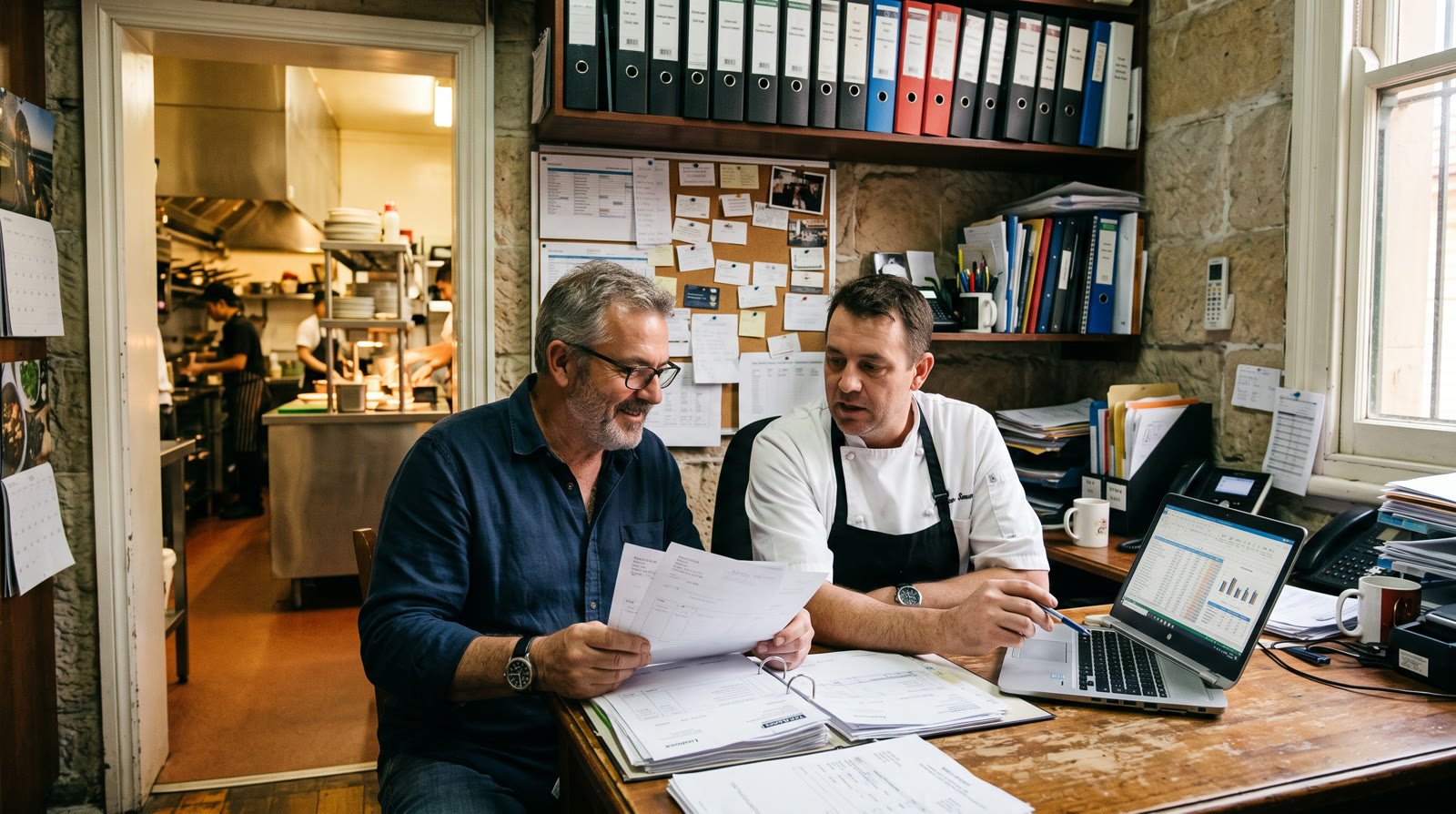
Food cost percentage is cost of food sold divided by food sales, and beverage cost percentage is the same for drinks. Many venues aim for food cost somewhere between about 28% and 35% of food sales, but the useful number is not the industry rule of thumb; it is your own figure, tracked weekly, with the trend explained. For that you need three things in the software: supplier bills captured and coded to food, beverage or consumables as they arrive (Hubdoc, MYOB Capture or the QuickBooks receipt tool do this from a photo or an emailed PDF), a stocktake value at the start and end of the period, and sales split by food and beverage from the POS.
Restaurant inventory software (MarketMan, Lightspeed’s inventory module and the others) adds recipe costing and par levels, and is worth it for a venue above a few million in sales or a group. For a single cafe, a monthly stocktake entered as a journal and a weekly look at purchases against sales catches most of what matters: a supplier price rise nobody noticed, portions creeping up, wastage on a line that is not selling, or a delivery that was signed for and never arrived. Code the purchases to the right category on the day the bill arrives; a bill coded to “purchases” in bulk at month end tells you nothing. Our accounts payable service does the daily capture and coding.
GST on food: what a cafe charges GST on
The ATO’s GST and food rules, with the taxable food and GST-free food lists last updated on 26 February 2026, are simpler for a venue than for a grocer. All food and beverages for consumption on the premises from which they are supplied are taxable, and so is all takeaway hot food and all takeaway hot beverages. That covers every dine-in meal, every coffee and every hot takeaway. The exceptions are the cold basic foods a cafe sells to take away: a loaf of bread, a bag of coffee beans, a carton of unflavoured milk, fresh fruit. The ATO’s own example is that bread rolls are GST-free unless they are consumed in a restaurant.
In the software this means a GST-free sales account and a GST-free item code on the POS for those retail lines, and a check at BAS time that the GST-free sales total looks like the retail shelf and not like a bug. Purchases run the other way: most ingredients bought raw (meat, vegetables, milk, flour) are GST-free, so the input tax credits on a cafe’s food bill are smaller than owners expect, while beverages, confectionery, prepared meals and consumables carry GST. A supplier bill captured with the GST read from the invoice rather than assumed gets this right every time. The BAS lodgement guide walks through the labels, and ATO due dates lists the lodgement calendar.
Hospitality bookkeeping: the weekly, monthly and quarterly routine
Hospitality bookkeeping is a rhythm rather than a monthly catch-up. The table is the routine our accountants run for cafe and restaurant clients; a venue owner can run it, or hand it to a bookkeeper with the software set up as above. Our guide to what a bookkeeper does covers the general version.
| When | Restaurant bookkeeping checklist |
|---|---|
| Daily | POS end-of-day summary posted; cash count and banking recorded; till variance noted; supplier bills photographed and sent to capture. |
| Weekly | Bank feed reconciled (card settlements, delivery payouts, cash deposits); supplier bills coded and scheduled for payment; roster approved and pay run processed; STP lodged; super paid under Payday Super; food and beverage cost against sales reviewed. |
| Monthly | Stocktake journal; delivery platform statements reconciled gross to net; gift card and deposit liabilities reconciled; wages, rent and food cost as a percentage of sales reviewed; profit and loss by venue or by day-part. |
| Quarterly | BAS prepared and lodged (GST-free sales checked, GST on purchases checked against supplier invoices); PAYG instalment reviewed; award pay rates checked against the current Fair Work pay guide; annual leave and long service leave liabilities for permanent staff updated. |
| Yearly | STP finalisation by 14 July; liquor licence, lease and insurance renewals diarised; 1 July pay rate changes loaded; records kept for the period the ATO requires (generally five years). |
Cafe bookkeeping: what is different from a restaurant
Cafe bookkeeping is the same routine with more transactions and smaller amounts: more card payments, more cash, more retail lines (beans, bread, pastries to go) and therefore more GST-free sales to keep separate. A cafe also tends to have a shorter roster of casuals under the Restaurant Award if it is mainly eat-in, or the Fast Food Award if it is mainly takeaway, and the award decision should be written down with the reasons, because it is the first thing a Fair Work inspector asks. Coffee bean and milk purchases are the two lines to watch weekly; between them they are usually the largest cost of goods in a cafe and the first to move when a supplier reprices.
Accounting software for bars and pubs
Accounting software for hospitality venues that are mainly bars or pubs has one extra problem: beverage stock. Liquor is bought by the case and keg, sold by the glass, and shrinks through spillage, free pours and theft, so beverage cost percentage swings more than food cost and needs its own stocktake and its own account. The POS feed should split beverage sales from food sales, and from gaming and accommodation if the pub has them, because each has a different margin and in a hotel each may fall under different parts of the Hospitality Award. Bars also carry the heaviest late-night and weekend penalty rates and the longest casual rosters, which is where a rostering app connected to the payroll pays for itself fastest. Xero with Lightspeed or Tyro, or MYOB Business Pro with MYOB Team, are the usual pairings; our hospitality bookkeeping service runs both.
Restaurant accounting: the five numbers to watch each week
Accounting software for hospitality is only useful if it produces a few numbers the owner reads every week. With the software set up as above, these five come out of the ledger without extra work.
- Sales by day and day-part against the same week last year, from the POS feed.
- Food cost and beverage cost percentage, purchases plus stock movement over sales, by category.
- Wages as a percentage of sales, including super and the casual loading, from the pay run against the POS sales for the same week.
- Cash in bank against commitments: the supplier bills due this week, the pay run, the BAS instalment accruing, rent.
- Delivery platform margin: gross delivery sales less commission and fees, so you know whether the delivery trade is adding profit or only volume.
Restaurant profit margin after all of that is thin in a normal year, which is why the weekly figures matter more than the annual accounts. Wages and cost of goods between them take most of every dollar, and both can be moved within a week by a roster change or a menu price.
How FreeMyCloud runs the books for a cafe, restaurant or bar
FreeMyCloud gives each hospitality client a dedicated, university-qualified accountant working in the client’s own Xero, MYOB, QuickBooks or Reckon file, supervised from Australia, for about 50% less than employing a bookkeeper locally. The accountant runs the routine in the table above: POS summaries posted, bank feed reconciled, supplier bills captured and coded, the pay run processed under the right award with STP lodged and super paid, food and beverage cost reported weekly, and the BAS prepared for the registered agent to lodge. The owner keeps the software, the data and the logins, and gets a short weekly report with the five numbers. See hospitality bookkeeping, work out the saving on the cost calculator, or book a call back with our team.
Accounting software for hospitality: questions people ask
What is the best accounting software for restaurants in Australia?
For most restaurants it is Xero or MYOB Business, because both connect to the common POS systems (Square, Lightspeed, Tyro) and rostering apps (Deputy, Tanda, MYOB Team), both run Single Touch Payroll, and both price payroll by headcount. Xero has the larger app store; MYOB is cheaper for a roster above about 15 people and does more award handling inside the product. QuickBooks Online suits a venue already on it; Reckon One is the lowest-cost ledger for a small cafe. Our four-way comparison goes through them on price, payroll, users and BAS.
What is the best accounting software for cafes?
For a cafe with one POS and a few staff, Xero or MYOB Business are the usual choices, because both connect to Square, Lightspeed and Tyro and post the day’s sales without anyone retyping them. A single cafe that enters one end-of-day summary can run on Reckon One at a lower monthly cost, and QuickBooks Online suits a cafe already using it. Whichever you choose, check that the POS link separates GST-free and taxable sales, because a cafe sells both.
Does Square connect to Xero?
Yes. Xero is listed on Square’s Australian app marketplace, and once connected Square posts a daily sales summary to Xero and its settlements match against the bank feed. Check that the integration separates GST, GST-free sales, surcharges and tips before you rely on the figures for BAS.
Which award covers cafe staff?
A cafe that mainly sells food and drink to be eaten on the premises, or offers table service, is under the Restaurant Industry Award, which names baristas in mainly eat-in cafes among its covered employees. A mainly takeaway cafe is under the Fast Food Industry Award. A cafe inside a hotel is under the Hospitality Industry (General) Award. Write the decision and the reason down, and set the software’s pay items to that award.
Do I charge GST on takeaway coffee and food?
Yes on anything hot and anything eaten in. All food and drink consumed on the premises is taxable, and so is all takeaway hot food and hot drink. Only cold basic food sold to take away (bread, unflavoured milk, fresh fruit, bagged coffee beans) can be GST-free, under the ATO’s GST-free food list.
How much does hospitality accounting software cost?
At list prices on 14 October 2026, a cafe paying five people pays about $56 a month on Reckon One, $85 on MYOB Business Pro, $90 on QuickBooks Essentials with payroll and $107 on Xero Comprehensive. A restaurant paying 20 people pays about $56 on Reckon, $130 on MYOB Pro, $180 on Xero Ultimate 20 and $204 on QuickBooks Plus with payroll. Rostering apps, bill capture beyond what is included, and inventory software are extra.
Can FreeMyCloud run the books for my cafe or restaurant?
Yes. A dedicated FreeMyCloud accountant works in your own Xero, MYOB, QuickBooks or Reckon file and runs the daily, weekly, monthly and quarterly routine above, including award payroll with STP and Payday Super, for about 50% less than employing a bookkeeper locally. Lodgement of the BAS is done through a registered agent. Start with the hospitality bookkeeping page or book a call back.